Other Activities to Try

Intro (talk together):
- “Did you know you’re made of stardust?”
- “What do you think stars are made of?”
- “Long ago, there were no planets—just gas. That gas came together, and stars were born!”
Activity:
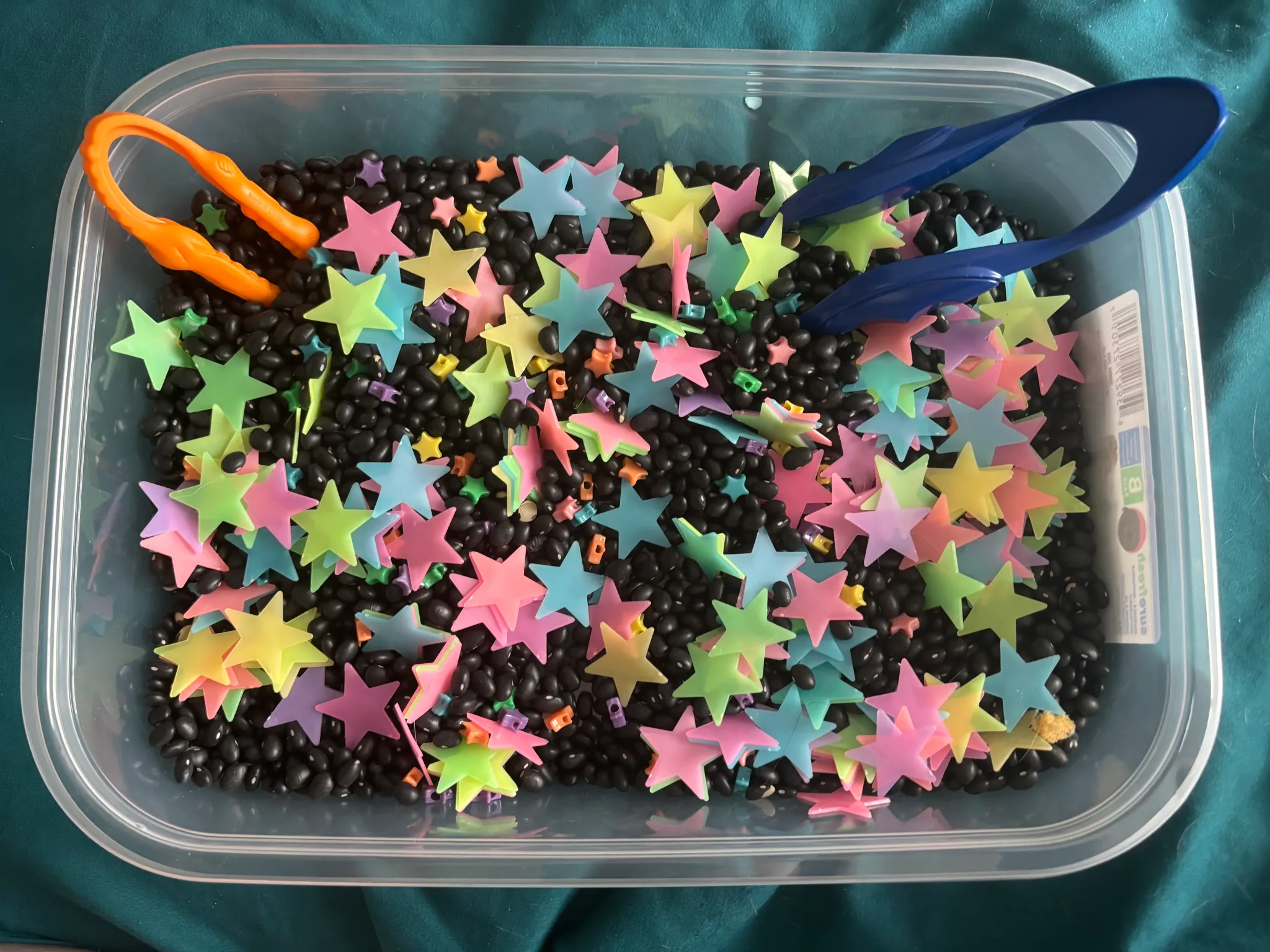
- Use a bowl as “space.”
- Add yellow/white pompoms = hydrogen.
- Add red/orange beads = helium.
- Add foil bits/pipe cleaners = heavier elements.
- Stir to make “star soup.”
- “What surprised you most about stars?”
- “What’s something you learned you’d like to share?”
Optional printable:
Formation of Stars Flipbook (pdf)
1. The Early Universe
Long ago, after the universe was born in the Big Bang, the cosmos was dark and empty. There were no stars, no planets, and no people—only vast clouds of gas floating through space.
These clouds were mostly hydrogen and helium, the simplest elements. They drifted slowly, almost like a whisper across the cosmos.
But something invisible began to act: gravity. Gravity pulls matter together. Slowly, the gas clouds started to clump, pulling tighter and tighter.
2. Birth of the First Stars
As the gas was squeezed, it heated up. Eventually, the gas became so hot and dense that nuclear reactions began—this was nuclear fusion, the process that powers stars.
Hydrogen atoms fused together to form helium.
Later, helium fused into heavier elements like carbon, oxygen, and iron.
At that moment, the first star was born! It blazed with light, filling the darkness and starting the long story of the universe’s chemistry. Stars became cosmic kitchens, creating the ingredients for planets, life, and even you.
3. The Life Cycle of Stars
Stars do not live forever. Their life depends on their size:
- Smaller stars (like our Sun) burn fuel slowly and shine for billions of years before becoming white dwarfs.
- Massive stars burn fuel quickly and end in giant explosions called supernovas, scattering newly made elements into space.
- This stardust drifts through space, gathering into new clouds, forming new stars, planets, and solar systems.
The iron in your blood, the oxygen you breathe, and the calcium in your bones were all created inside stars long before Earth existed. In a very real sense, we are made of star stuff. And the story continues—every night, new stars are born in distant nebulae. The universe is still changing, still creating, and still full of mysteries waiting to be discovered.