
Scientist Spotlight: Marie Tharp
Core Concepts
- Marie Tharp was a geologist and mapmaker.
- She helped create the first detailed map of the ocean floor.
- Her work helped support the theory of plate tectonics and continental drift.
- People didn’t believe her at first—because she was a woman—but her maps changed science forever.
- Globe or ocean floor map (can use Google Earth or printout)
- Image of Marie Tharp (available via web search)
- Crayons or watercolors
- Access to map or topography examples
- Optional: short read-aloud biography (see suggestions below)
Read a book about Marie Tharp (more in resources) OR tell one of these stories introducing her:
Tell the story (Level 1):
"Marie Tharp loved maps. She wanted to understand what was under the ocean. But no one had ever made a real map of the sea floor before. People thought it was flat! Marie worked with scientists who used sound to 'see' under the water. She turned that information into beautiful maps. Her maps showed deep valleys and big mountains under the sea. She discovered something called the Mid-Atlantic Ridge, which helped prove that the Earth’s crust is moving!"
For Level 2, add:
"Marie Tharp used sonar data collected by ships. She wasn’t allowed on the ships herself because she was a woman. But back in the lab, she studied the soundings and turned them into detailed maps. She was the first person to see a long crack in the middle of the Atlantic Ocean. That crack was part of the Mid-Atlantic Ridge, a key piece of evidence that supported continental drift and the idea of seafloor spreading."
Visual Exploration
- Show students a simple ocean floor map. Point out:
- Mountains
- Valleys
- The Mid-Atlantic Ridge
- Compare with a flat ocean to show how Marie’s maps changed understanding.
Art / Hands-On Mapping Activity
Level 1:
- Color or watercolor a simplified ocean map
- Draw “bumpy” lines for the ridge. Add ships or sound lines.
- Create a sonar “map” on paper: use a ruler or string to create ocean depth lines.
- Label: Mid-Atlantic Ridge, ocean floor, continents.
- Try a salt dough or modeling clay 3D model of the ocean floor.
Wrap-Up & Reflection Questions
- Why was Marie Tharp’s map so important?
- What did her map show us about the ocean floor?
- Why do you think people didn’t believe her at first?
- What would you like to map?
Add Marie Tharp to your science timeline:1950s–1970s – Marie Tharp maps the ocean floor and supports plate tectonics
 Books
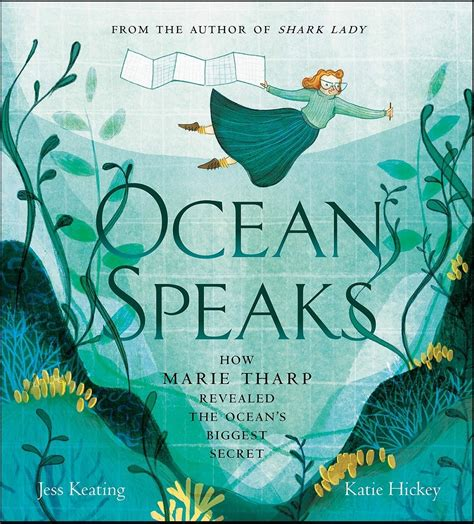
Books- Ocean Speaks: How Marie Tharp Revealed the Ocean's Biggest Secret by Jess Keating (picture book, great for both levels)
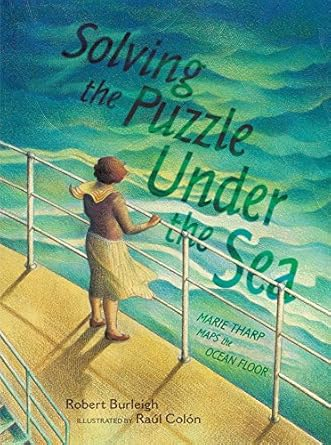
- Solving the Puzzle Under the Sea by Robert Burleigh (picture book)
- Marie's Ocean: Marie Tharp Maps the Mountains Under the Sea by Josie James (picture book)
- Soundings: The Story of the Remarkable Woman Who Mapped the Ocean Floor by Hali Felt (adult)